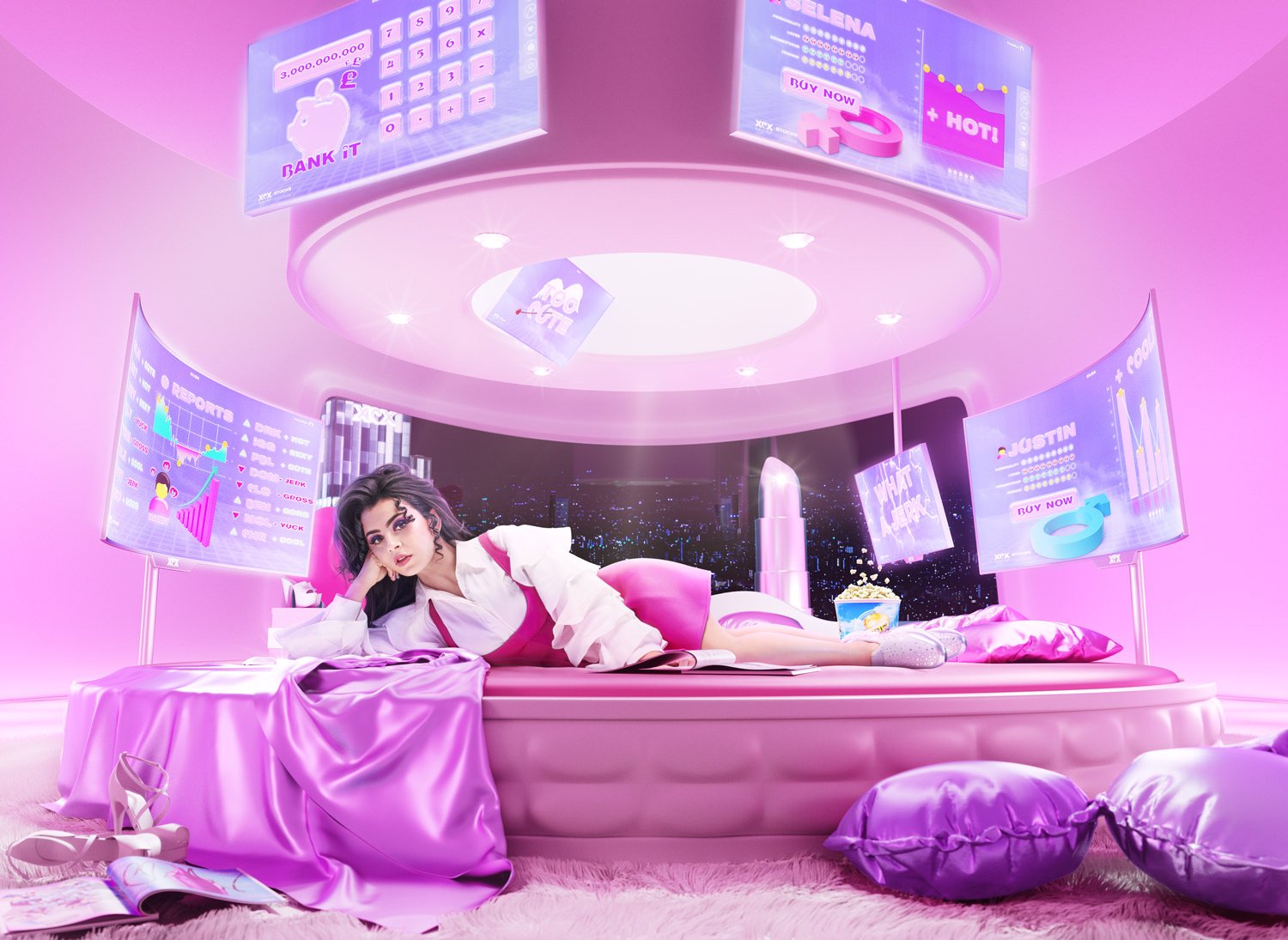
Right now, Charli XCX is heralded as the “pop star of the future”, named by acclaimed magazines as the “anti-popstar” by Pitchfork and other sites. But before she became a critical darling, she was a commercial success: deemed a typical sellout popstar, but a successful one. She started off her career and was thrown into the spotlight with multiple top ten hits, such as Fancy featuring Iggy Azalea, Boom Clap, and Break the Rules, dominating the radios around 2014-2015. But the more she became the stereotypical pop-star, controlled by her managers and forced to stay within the boundaries of what’s considered acceptable in the pop field, the more she craved authenticity. This is shown through her mixtape, Pop2, a blend of her need for creativity and authenticity with the basic pop-algorithm. She pushes pop, stereotypically seen as a basic, meaningless, and shallow form of music, to its very limits. As she says in “Femmebot”, one of the songs off the mixtape, “I’m an upgrade of your stereotype’.
It’s a bold statement but she fulfills this promise.

POP2’S OVERARCHING CONCEPT IS: “WHAT WOULD POP MUSIC SOUND LIKE IN THE FUTURE? IN THE NEXT 50/100 YEARS?”
For Charli, the future consists of a hyper-developed, technology-reliant, robotic world, where humanity is lost. Thus, even the pop music of the future lacks any sort of humanoid quality, as Charli purposefully layers her voice in Pop2 with autotune, in order to make the entire project sound apathetic and sterile, as if it was created by a robot specifically catered to make pop music.
However, not only does the project sound futuristic, but lyrically, the project embodies the lack of meaning and connection caused by futuristic technology, in a society similar to the World State. For Charli, the future is a world where love and true emotions no longer exist; materialism and hedonism are the highest values; Porsches and other luxury items are venerated. Everyone excessively parties to prevent themselves from feeling something, to escape from their emotions. Throughout the mixtape, Charli confronts the loneliness and lack of human connection caused by such a society and demonstrates humanity’s inherent need for something deeper than pleasure and happiness: love. However, Charli also embodies the difficulty in attaining emotional connection in a society specifically structured to place happiness as the highest value. In her journey for love and connection, she encounters pain, heartbreak, and more, and once things get difficult, she ultimately resorts to hedonistic pleasures, such as partying, as an emotional refuge, to forget about it all: her values, her desire for love, her morals. Thus, Pop2 represents the choice between emotional connection, which comes with pain, or simple hedonistic pleasures, which allows one to forget about one’s need for more than happiness.
The opening track of Pop2, “Backseat” featuring Carly Rae Jepsen, introduces Charli’s emotional isolation and her use of hedonistic pleasures as a coping mechanism to numb her loneliness. The song starts with grating uncanny synths, introducing the listener to the futuristic soundscape and concept of the album. Charli’s use of strange industrial sounds, not only at the beginning, but throughout the album, continue to remind the listener that Pop2 takes place in charli’s vision of a future society, everything is replaced by technology, even music. Drums and keyboards no longer exist, and are instead replaced by robot computer-engineered sounds. In the Pop2 world, music is no longer used as a form of connection or expression, as it is all engineered through technology and computer algorithms.
VERSE 1
I can’t escape all the voices, and so, I turn it up
I go to parties with strangers so I can figure it out
Run through a city at midnight to feel like a star
I want it all, even if it’s fake
In the futuristic world that Charli envisions humanity to be in 50 years, she believes people will use hedonism and escapism as a coping mechanism to the lack of values of the world, which the first verse describes.; When the voices in her head desire something more than simple pleasures, something of value, she uses music to drown them out. But when that doesn’t work, she goes to “parties with strangers”; not to form connections, but to escape and have fun through physical pleasure. In a world where she’s constantly surrounded by bodies, she may be physically connected, but alas, they’re all ‘strangers’ and she lacks any sort of emotional connection to them. She does it all, just to ‘feel like a star’: to feel happiness and simple pleasure, at the expense of deeper values such as true emotional connection. But Charli isn’t blind. She’s a self-aware hedonist, and knows that her happiness is ‘fake’ and ‘shallow’, but she wants it BECAUSE they allow her to let go of deeper values such as connection. They let her ‘escape’ the voices that desire for more, for values, values that she believes are hurtful as shown in the next verse.
VERSE 2
Breakin’ your heart, split it in half
Told you it all (told you it all)
Year and a half, are we in love?
I’ll never know (I’ll never know)
I know I’m wrong, what a mistake
Don’t ever change (don’t ever change)
I can’t escape all the voices, and so, I turn it up
In the second verse, Charli recounts the instability and pain one must endure once one searches for love and real connections. The desire for love inevitably comes with heartbreak, pain, and insecurity, which has caused Charli to denounce love and consider her desire for deep values as “a mistake”. However, her cynicism for deeper emotions is only surface-level, as she admits that inside, she’ll “never change’. She’ll never stop yearning for true connection and love, but in order to protect herself and avoid the pain that comes with deeper values, she chooses to resort to hedonism, “turning it up” and drowning out her desire for connection.
CHORUS
(Your song) so loud
(Drivin’) so fast
I’m better off alone
All alone, all alone, all alone
The chorus consists of Charli indulging in hedonism, overloading her senses (driving fast, playing loud music) in order to avoid her desires for connection.
Once again, Charli describes sound and music not as a form of connection and meaning, but as something that can be turned up, can be so loud as to overload the senses and drown out her desires for connection that she knows will cause pain. In the end, she tries to convince herself that she’s “better off alone”, free of any meaningful human connection, but also free of the pain that comes with it.
However, in the post-chorus, Charli’s use of hedonism fails to prevent her yearning for human connection, as shown by how she repeats, “All alone”. Her attempts to distract herself only serve as a reminder of how alone she truly feels, and the repetitiveness of the phrase, “all alone”, only serves to show how crushing her loneliness is.
As the song progresses, the phrase “all alone” becomes more and more distorted each time it’s repeated. As layers of autotune and distortion slowly get added to Charli’s vocals, they become less and less human, and more and more robotic, showing how Charli’s hedonism and lack of human connection eventually strips away her humanity, making her no different than a robot. Eventually, her cries of loneliness become so distorted and robotically warped that one can’t possibly make out her words.. They get lost in the industrial synths, showing how her reliance on technology and sensory overload to escape her loneliness has completely overwhelmed her. In her attempt to avoid the pain that comes with human connection, she’s become a robot of the society she lives in, with no values whatsoever.
FEMMEBOT
However, even though, by the end of BackSeat, Charli becomes a ‘robot’ and has lost humanity, not all hope for connection and values in the future is lost.
In FemmeBot, Charli also shows that love and connection can still prevail in such a technological and futuristic society, where even robots, who typically lack humanity and values, can also find connection/love. The track was inspired by the feminine robots created today, such as robots like Sophia and others, who are hyper-sexualized today. Instead of viewing the sexualization of robots as something weird, Charli views it as hope: hope that if soulless products of technology can find love or be loved, then so can humans.
But more importantly, Charli describes how the future isn’t always negative. With the future and the technology it brings, Charli predicts that gender boundaries would grow more and more blurred as humanity lets go off conservative values and grows more accepting of people that “transgress” typical gender identities. Plus, as technology advances, more and more people would be able to get the body modifications that allow them to embody their true gender, without fear of having to hide who they truly are.
This blur in gender boundaries is shown through the two guest artists, Dorian Electra and Mykki Blanco. Dorian Electra, through the use of vocal effects, comes off as both feminine and masculine at the same time, while Mykki Blanco, a male rapper, raps about being a femmebot, showing the dropping of traditional values and the potential the future has.
TRACK 10
The song starts of with a bunch of glitches, messed up, distorted and industrial sounds, representing the hedonistic technological future. However, the instrumental quickly strips itself off the strange futuristic sounds heard throughout the album, and are replaced with bird chirps and a xylophone. This switch towards natural sounds, such as the bird chirps, is accompanied by Charli’s most vulnerable and emotional lyrics in the album, proving Charli’s point that technology of the future often strips one of one’s humanity and ability to feel emotions, and that a reversion towards the past, towards nature, allows one to regain their humanity and vulnerability.
Throughout the entire mixtape, we see Charli running away from human connection, using parties, drugs, and technology to escape from her desire for love. However, in Track 10, the closing track of the album, Charli is at her most vulnerable and opens up about why she runs from intimacy.
VERSE 1
Every time you get too close I run, I run away
And every time you say the words, I don’t know what to say
Back, back to the beginnin’ really wish that I could change
I do, I do (I do)
As she admits in verse 1, she doesn’t despise the value of love: in fact, she truly wishes she could “go back to the beginning” and change. She wishes she could find love, but she views intimacy as something dangerous, as shown in the chorus.
CHORUS
I blame it on your love
Every time I fuck it up
I blame it on your love, I do
She reveals the dangers of intimacy lie in her self-destructive tendencies. Whenever she gets a relationship or connection with someone, she always messes up, and instead of owning up to her own errors, she instead blames it on the emotion of love. By repeatedly deflecting the blame onto love, she herself begins to fear love, and resorts to hedonism in order to forget about connection and escape from her desire for love. Her fear for love and the self-destructive tendencies that love brings have caused her to run away from intimacy, and self-sabotage her relationships with hedonistic pleasures whenever she gets too close with someone.
However, as the song progresses, Charli realizes that her habit of blaming her own mistakes on love was wrong, and owns up to it, saying “sorry, I blame it on your love”. She realizes that it isn’t love she needs to be afraid of, it’s her own responsibility and destructive hedonistic habits that have destroyed her connections. As she owns up and apologizes, the instrumental swells up and into some sort of futuristic choir, appropriate for the revelation she just experienced.
Through the sheer vulnerability of Track 10, Pop2 ends with a trace of humanity, showing that in a world so advanced, maybe human connection can continue to stay.
 Musing About Music